 TouchéGet the app
The first World Cup final used a different ball in each half
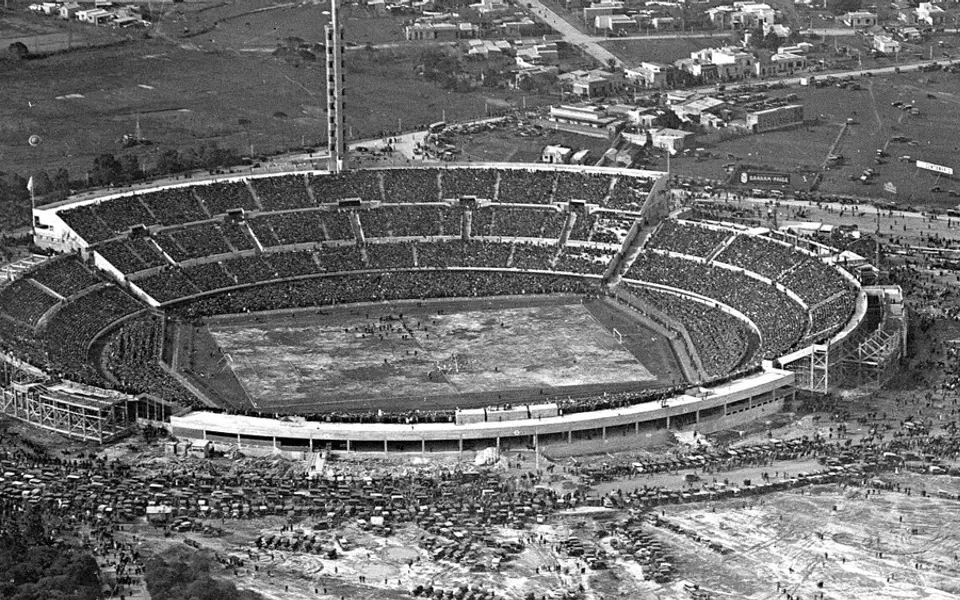
On July 30, 1930, Uruguay and Argentina met in Montevideo in the first World Cup final, and they could not agree on whose ball to play with.
On July 30, 1930, Uruguay and Argentina met in Montevideo in the first World Cup final. Before the kickoff, the two teams argued over which of them would supply the match ball.
At that tournament the two teams in each match had to agree on a ball. Most games were played with the T-Model, the ball Uruguay preferred. Argentina preferred a 12-panel ball called the Tiento.
The two countries had met in the Olympic final two years earlier, and Uruguay had won it 2 to 1 after a replay. On the day of the World Cup final, thousands of Argentine fans crossed the river from Buenos Aires by boat, with the war cry "Victoria o muerte," victory or death. The port at Montevideo was so overwhelmed that many of them had not even landed by kickoff. At the stadium, fans were searched for weapons. The gates opened at 8 a.m., six hours before the game, and by noon the ground was full.
The ball dispute was settled with a compromise: Argentina's ball for the first half, Uruguay's for the second. The referee, John Langenus of Belgium, had asked for a plan to get him back to his ship quickly after the match.
Erling Haaland plays for which national team?
WhyHaaland was born in Leeds while his father played for Leeds United, and moved to Norway when he was three. At the 2019 Under-20 World Cup he scored nine goals for Norway in one game.
Uruguay scored first, through Pablo Dorado after 12 minutes. Argentina equalized eight minutes later, and shortly before halftime Guillermo Stábile, the top scorer of the tournament, put them ahead. Uruguay's captain protested that Stábile was offside, and got nowhere. Argentina went into the break leading 2 to 1 with its own ball.
The second half was played with Uruguay's ball. Pedro Cea equalized 12 minutes in. Santos Iriarte put Uruguay ahead in the 68th minute, and Héctor Castro made it 4 to 2 a minute from the end.
Jules Rimet, the president of FIFA, handed over the trophy that would later carry his name. Uruguay declared the next day a national holiday. In Buenos Aires, a crowd threw stones at the Uruguayan consulate.