 TouchéGet the app
In 1971 an astronaut took a six-iron to the Moon
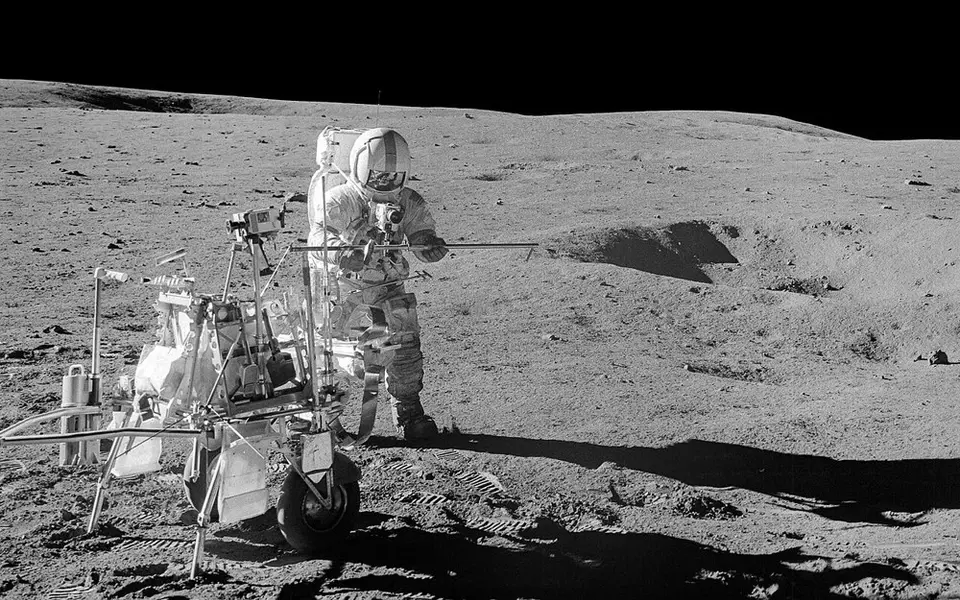
On the Apollo 14 mission in February 1971, Alan Shepard fitted the head of a six-iron onto a tool handle and hit two golf balls on the Moon.
Near the end of their second walk on the Moon, in February 1971, Alan Shepard and Edgar Mitchell came back to their lunar module and into view of its television camera. Shepard then did something he had been planning for years, in case he ever got there.
He had brought the head of a Wilson six-iron, modified to fit the handle of a tool meant for scooping up samples, and two golf balls. His spacesuit did not bend enough for a two-handed swing, so he swung with one hand. After several swings he announced that the second ball had gone "miles and miles and miles."
Mitchell joined in. He threw a scoop handle as if it were a javelin. The javelin and one of the golf balls ended up in the same crater, with the javelin a little farther on. Shepard later said the other ball landed near the science experiments they had set up.
Shepard was 47. In 1961 he had become the first American in space, and two years later an inner-ear disorder that caused attacks of dizziness grounded him. Experimental surgery in 1968 put him back on flight status. He was the only one of NASA's original seven astronauts to walk on the Moon.
Which country hosted the 1992 Summer Olympics?
WhyAn archer lit the Barcelona cauldron by shooting a flaming arrow over it. It was the first Games in decades with no boycott.
Not everyone liked the golf. Earlier on the same walk, the two men had set out for the rim of Cone crater, one of the main goals of the mission. The ground looked different from their maps, they kept overestimating how far they had come, and Mission Control told them to take samples where they were and head back. Pictures later showed they had come within about 65 feet of the rim. The geologist Don Wilhelms wrote that "the golf game did not set well with most geologists."
There are no still photographs of the shots. The only record is the television footage. Shepard brought the club home and gave it to the USGA Museum in New Jersey, and he gave a replica to the National Air and Space Museum.
In February 2021, for the mission's 50th anniversary, the imaging specialist Andy Saunders made digitally enhanced images from the footage and used them to work out where the balls had landed. The first went about 24 yards. The second, the one that went miles and miles, went about 40.