 TouchéGet the app
The 808 drum machine died because transistors got better
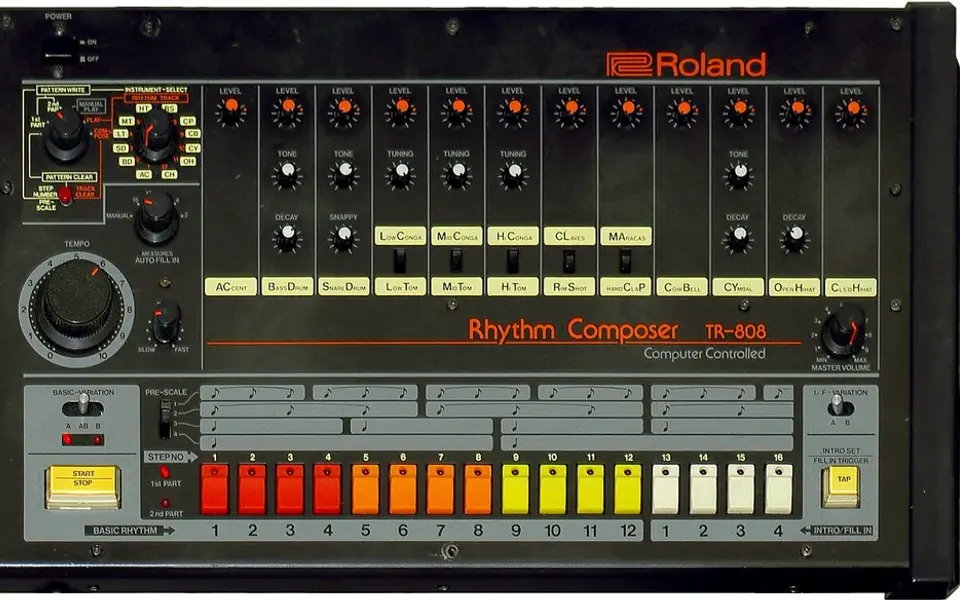
Roland's TR-808 came out in 1980 and flopped. Many musicians wanted drums that sounded real, and its drums did not.
In 1980 the Japanese company Roland put out the TR-808, a drum machine with a list price of $1,195. Roland expected musicians to use it mainly for making demos. Its main rival, the Linn LM-1, cost $4,995 and played back recordings of real drums.
Roland's founder, Ikutaro Kakehashi, had asked for a cheap machine with realistic drum sounds. Memory chips were too expensive to store recordings of drums. So the chief engineer, Tadao Kikumoto, proposed a different approach: build every sound from scratch with analog circuits. Kakehashi deliberately bought faulty transistors, which gave the machine a sizzling sound.
The result did not sound like a drum kit. Its sounds have been described as clicky and toy-like. One magazine called its cowbell "clumsy, clonky and hopelessly underpitched." The bass drum was a tone that a single knob could stretch into a long, low boom.
Electronic music was not yet mainstream, and many musicians and producers wanted drums that sounded real. The 808 sold poorly. In 1983 Roland stopped making it, after building about 12,000. By then semiconductors had improved, and the faulty transistors the design depended on could no longer be bought.
A sousaphone is a marching version of which instrument?
WhyJohn Philip Sousa was unhappy with the helicons the Marine Band used, so in 1893 James Pepper built him a tuba-like horn with the bell pointing straight up. People nicknamed it the rain-catcher.
Used 808s were already common, often for less than $100. The low price, along with the odd sound, won it a following among underground musicians and producers. In 1982 Marvin Gaye had used one on "Sexual Healing," the first US hit with an 808. He liked that he could make music with it alone, without other musicians or producers.
That same year Afrika Bambaataa's group recorded "Planet Rock" with 808 beats. They did not own one. They found it through an ad in The Village Voice: a man with a drum machine, $20 a session.
Hip-hop took to the 808's bass drum. The producer Rick Rubin popularized a way of using it: lengthen the decay, tune the drum to different pitches, and play bass lines on it.