 TouchéGet the app
Citicorp Center was secretly reinforced at night in 1978
Less than a year after the tower was finished, its engineer, William LeMessurier, learned that his welded joints had been swapped for bolted ones, and that wind hitting a corner could strain them badly.
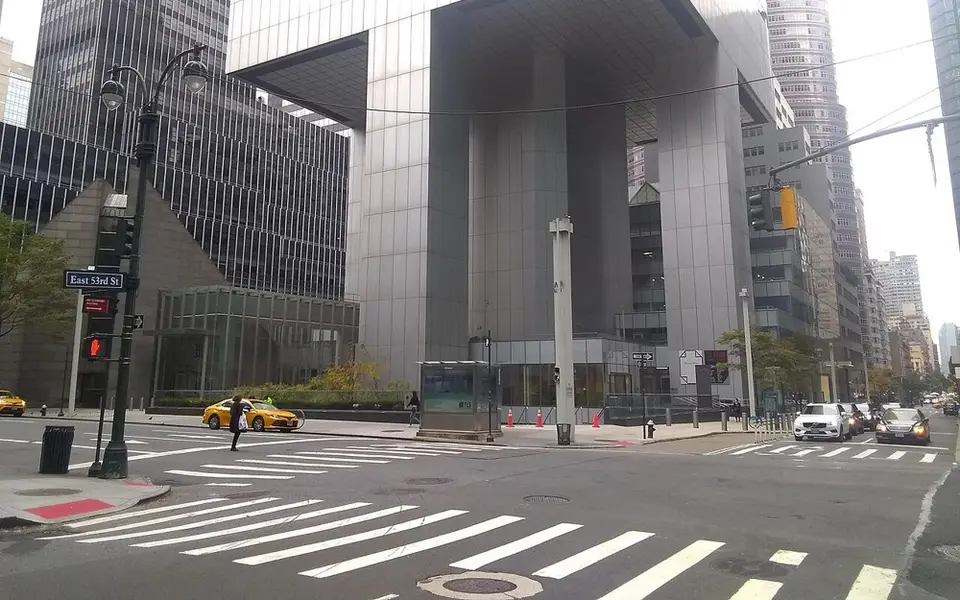
The tower of Citicorp Center in Manhattan, finished in 1977, stands on four stilts about 112 feet tall. They are not at the corners. Each one sits under the middle of a side, and the corners of the tower hang in the air above the street.
The reason was a church. St. Peter's Lutheran Church sold its land on the condition that a new church be built at the foot of the tower. Early plans put a stilt under each corner, but the northwest one would have run into the church, and the congregation wanted its sanctuary kept structurally separate from the tower.
To bring the tower's loads down to the middle of each side, the structural engineer, William LeMessurier, used stacked braces shaped like upside-down V's, each eight stories tall, hidden inside the walls. He designed their joints to be welded. In 1974 Bethlehem Steel switched to bolted joints to save money. LeMessurier's office accepted the change, but he did not know about it.
The building code asked engineers to check wind blowing straight at each face of a building. On a typical building, wind striking a corner, called a quartering wind, puts less strain on the frame, so LeMessurier had calculated only the head-on case.
What brown tone gives old photographs a vintage look?
WhySepia is the Greek word for cuttlefish, and the color was originally that animal's ink. Sepia toning is a chemical process that turns black-and-white prints brown, and many photo apps imitate it with a filter.
In June 1978 Diane Hartley, an engineering student at Princeton, contacted LeMessurier's office about the tower's wind loads. LeMessurier redid his numbers with quartering winds. They raised the load on the bolted joints sharply. By his estimate, a wind strong enough to topple the building had a 1-in-55 chance of coming in an average year. If the damper on the roof, a 400-ton block that steadies the tower, lost power, the odds became 1 in 16.
His fix was to weld 2-inch-thick steel plates over the bolted joints, more than 200 of them. Starting in August 1978, welders from Karl Koch Erecting did the work at night. It was finished in October. LeMessurier then put the chance of a toppling wind at 1 in 700 a year.
Very few people were told, and the work happened during the 1978 New York City newspaper strike. The full story came out in 1995, in a long New Yorker article titled "The Fifty-Nine-Story Crisis." It is now taught as a case study in ethics in architecture programs.
In 2019 the National Institute of Standards and Technology reassessed the case with modern methods. It found that quartering winds would not have loaded the building as heavily as LeMessurier and Hartley had thought.