 TouchéGet the app
Chicago jacked up its buildings while people shopped inside
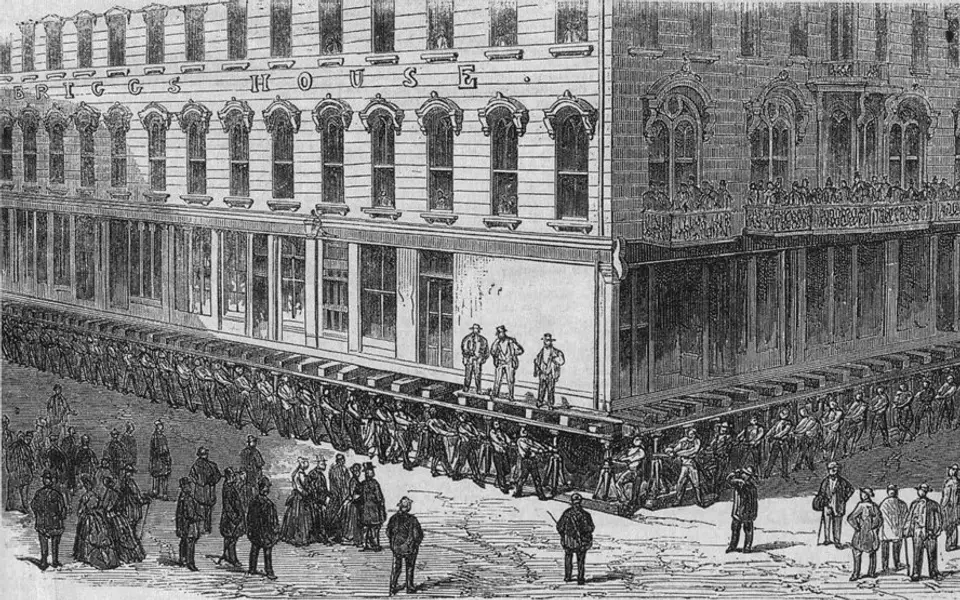
Central Chicago in the 1850s sat barely above Lake Michigan and could not drain.
In the 1850s central Chicago sat only a little higher than the shore of Lake Michigan. Water had nowhere to drain, and standing water bred disease. In 1854 a cholera outbreak killed six percent of the city's people.
In 1856 the engineer Ellis Chesbrough drew up a plan for a citywide sewer system, and the city adopted it. Workers laid the drains along the streets, then covered them, the roads and the sidewalks with several feet of soil. That left the ground floors of the old buildings below the new street. The buildings had to come up too.
In January 1858 a contractor from Boston, James Brown, lifted the first brick building: four stories, 70 feet long and about 750 tons. It went up 6 feet 2 inches on 200 jackscrews, "without the slightest injury to the building." More than 50 large masonry buildings were raised the same way that year.
The jobs got bigger. In 1860 a group of six engineers, George Pullman among them, took on half a block of Lake Street at once. It was a continuous row of four- and five-story brick and stone buildings, 320 feet long and an estimated 35,000 tons with its sidewalks. Six hundred men worked 6,000 jackscrews, and in five days the whole row rose 4 feet 8 inches. The shops, offices and printers inside stayed open, and people came and went as usual. Thousands came to watch. On the last day they were allowed to walk among the jacks at the old ground level.
Raising the Flag on Iwo Jima won which prize in 1945?
WhyJoe Rosenthal's prize-winning picture shows the second flag raised on Mount Suribachi that day. The first was too small to be seen from the north side, so a larger replacement was raised by different Marines.
In 1861 Pullman, working with the firm of Ely and Smith, raised the Tremont House, a six-story brick hotel that had been the tallest building in Chicago until the year before. The hotel stayed open while 500 men worked 1,000 jackscrews in covered trenches beneath it. Some guests never noticed. One was puzzled that the front steps grew steeper every day. When he checked out, windows that had been at eye level were several feet above his head. The hotel went up 6 feet.
Pullman had grown up in the trade. His father had invented a machine that used jackscrews to move buildings, and in 1856 Pullman won a New York State contract to move 20 buildings out of the way of the widening Erie Canal. He went on to design the Pullman railroad sleeping car.
Many wooden buildings were not worth raising. Their owners put them on rollers and moved them to the edge of town, sometimes with people still eating, shopping and working inside. A visitor, David Macrae, wrote that he passed houses on the move on every day of his stay. "One day I met nine."