 TouchéGet the app
Britain's new coins face a judge and jury every year
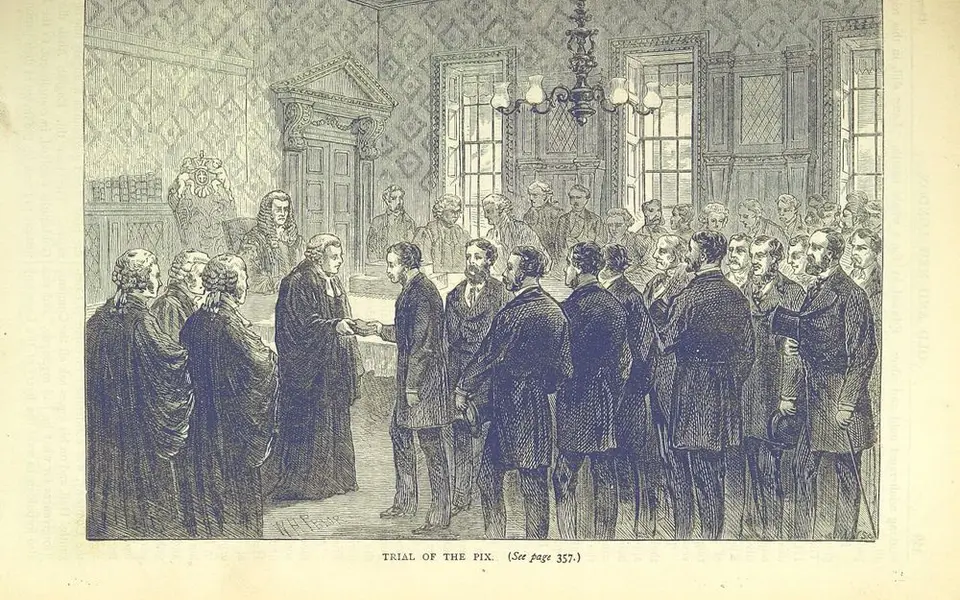
Each year the Royal Mint sets aside thousands of new coins, and a jury from the goldsmiths' guild tests them before a judge. The head of the Mint is, in effect, on trial.
Every year, usually starting in February, a court sits in the City of London to try the coins of the realm. It is called the Trial of the Pyx. The judge is the King's Remembrancer, a senior judicial officer of the High Court. The jury is made up of at least six assayers from the Goldsmiths' Company, the London guild that tests precious metals. The Deputy Master of the Mint, who runs the Royal Mint, is in effect the defendant.
The evidence is gathered all year. The Mint must set aside a fixed share of the coins it makes: one of every 5,000 two-metal coins, for example, and one of every 150 silver Maundy coins. At the hearing the jurors sit along a table and count packets of up to 50 coins. Each juror picks one coin from the pile and puts it in a copper bowl. Those coins go to the Goldsmiths' assay office, where they are melted into plates and compared with a trial plate of known purity. The rest are weighed. The verdict is given at a second ceremony, once the testing is done.
A master of the mint handled large amounts of gold and silver, and it would have been tempting to steal some. The trial checks that the coins have the size, weight and purity the law requires. If they fall short, the master can be fined, removed from office or imprisoned.
Records from 1179 already describe the Exchequer checking the weight and fineness of the coins it received. The oldest surviving record of a public trial dates from 1248, with a jury of twelve London citizens and twelve "skilful goldsmiths." In 1279 the master of the mint was ordered to set aside one coin for every ten pounds of silver he minted. The coins went into a box with two keys, one held by the master and the other by the warden, and were tested four times a year.
Paper money was first used in which country?
WhyPaper money appeared in Tang-dynasty China in the 7th century, first as merchants' receipts for coins. By the 11th century under the Song, true paper notes called jiaozi were circulating. Europe only followed centuries later.
The box gave the trial its name. Pyx comes from the Greek word for a wooden box. The pyx and the standard plates used for testing were kept locked in a room off the cloister of Westminster Abbey, still known as the Pyx Chamber.
In the early 17th century the monarch usually came to the trial in person. Since the 1870s it has normally been held at Goldsmiths' Hall, the guild's headquarters. The Coinage Act 1971 requires a trial in any year in which the Royal Mint issues coins, and there was one in every year of Elizabeth II's reign.
Today the Mint tests its coins in laboratories throughout the year. The trial goes on anyway.