 TouchéGet the app
A 1912 Olympic wrestling bout lasted 11 hours and 40 minutes
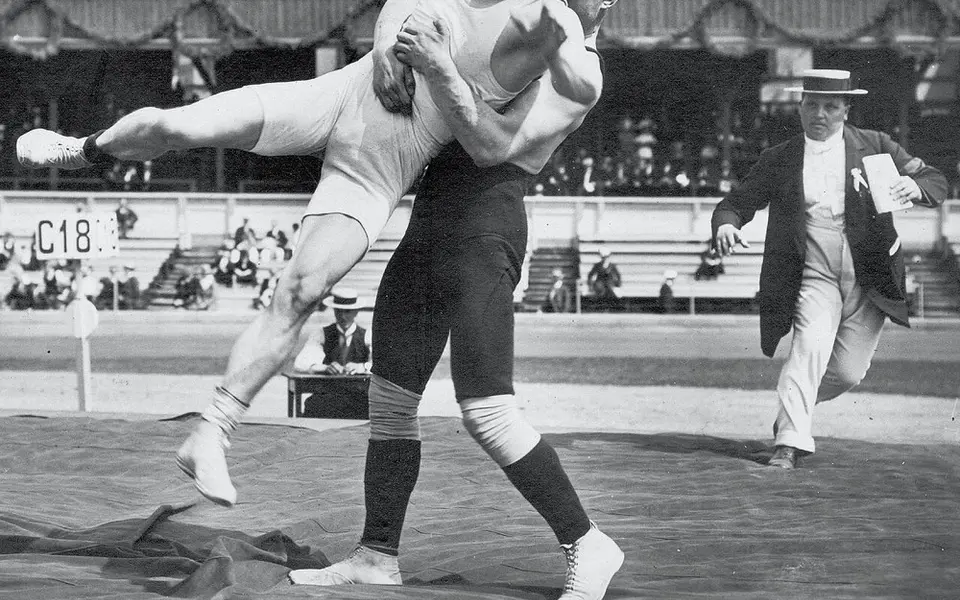
At the Stockholm Olympics, Martin Klein of Russia and Alfred Asikainen of Finland, the world champion, wrestled outdoors in the sun, resting briefly every half hour.
On a sunny day in July 1912, in the open air inside the Olympic Stadium in Stockholm, Martin Klein and Alfred Asikainen started a middleweight wrestling match. Eleven hours and forty minutes later, Klein pinned him.
Asikainen, from Finland, was the reigning world champion. Klein was an Estonian competing for the Russian Empire. He was a farmer's son who had gone to work in a factory in St. Petersburg, and he took up wrestling in his twenties, after he got a night job guarding a wrestling club.
The tournament had come down to three men, and earlier results no longer counted. The winner of Klein against Asikainen would wrestle Claes Johanson of Sweden for the gold.
The bout was Greco-Roman, the only style at those Games, and it had no time limit. After the first hour the two men were given a short rest, and after that a rest every half hour.
Michael Phelps competed in which sport?
WhyPhelps won 23 Olympic golds, but the story that he ate 12,000 calories a day in training is a myth. He has said the number was exaggerated, and that he never ate that much, even when he was still growing.
When Klein finally won, he was completely exhausted. He was ruled unfit to wrestle the final the next day, and Johanson became Olympic champion without it. Klein got the silver medal and Asikainen the bronze.
The light heavyweight final went much the same way. Anders Ahlgren of Sweden and Ivar Böhling of Finland wrestled for more than nine hours, neither could beat the other, and the match was declared a draw. The rules said the champion had to have defeated his opponent. So no gold medal was awarded, and both men got silver.
In 1921 an international federation took over the rules of Greco-Roman wrestling, and matches got much shorter. Time limits came to wrestling in 1924.